What's new in the rev.ng decompiler
Announcement
Hello again! We haven't posted in a while, so it's high time we gave you some updates about the rev.ng decompiler.
tl;dr You should give it another try!
How? Take a look at the initial setup guide and then head into your very first decompilation.
In this post we'll talk about some significant stability and performance improvements we've made, but keep in mind we're still doing some major work in this area, so expect rough edges.
If you have problems, please do not hesitate to reach out to us on Discord or to open an issue on GitHub. Don't forget to attach a reproducer :)
Note that today we're just going to talk about rev.ng, our open source decompiler engine. If you're looking for news about the UI, subscribe to the newsletter now: big news is coming soon there as well.
By the way, at rev.ng Labs we also do contract work. If you have a challenge for us about binary analysis, emulation or compilers, reach out. We're your guys.
Enough talk. Ready? Let's get into it.
Prototypes for 600k well-known functions
We now ship a database of prototypes for all the library functions of the following operating systems:
- Windows 11 x86-64, AArch64
- Windows 7 x86
- Windows 8 and 8.1 x86-64
- Ubuntu 24.04 x86, x86-64, ARM, AArch64, s390x
- Ubuntu 20.04, 22.04 x86-64
- Debian Buster MIPS (big endian)
- Debian Bookworm MIPS (little endian)
This means you get nice prototypes for all the Win32 library functions and for the most common libraries under Linux, out of the box.
Here's the difference it makes on a call to VirtualAllocEx, on the function signatures:
And in the function body:
Overall, the database currently provides 600k function prototypes, 590k structs, 564k typedefs, 34k unions and 20k enums.
The database is a plain SQLite file: if you're curious, you can take a look at it (1.86 GB).
Floating point support
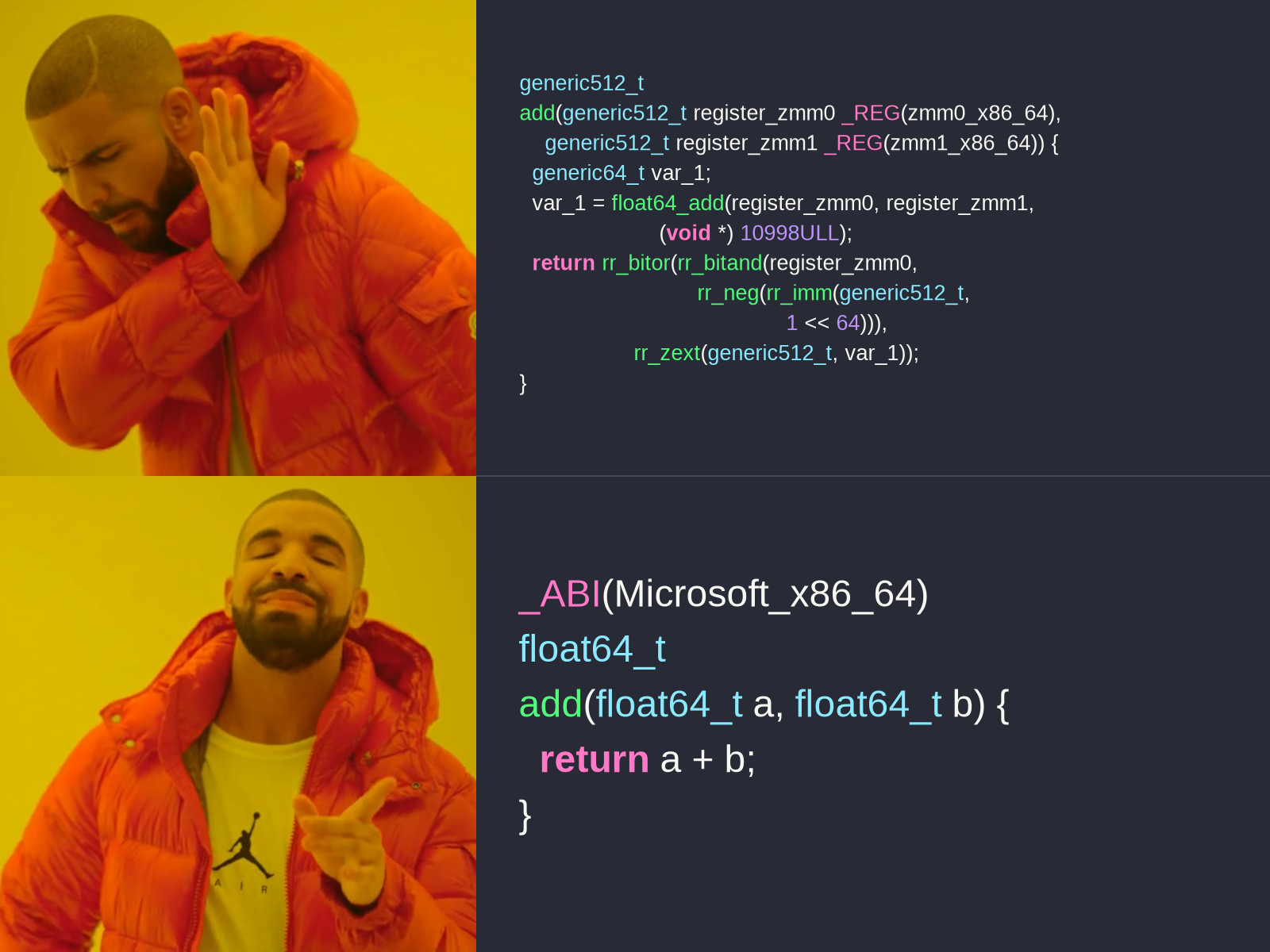
Support for floating point is finally landing in rev.ng. We now support floating point arguments in many calling conventions and emit floating point operations as plain C operators:
As of today, we mainly support it in the Microsoft x86-64, ARM (32-bit) and MIPS ABIs. Wider support is being worked on and will be merged soon.
Fewer casts
We now suppress casts that are not necessary according to the "integer promotions" and "usual arithmetic conversions", as specified by the C99 standard (§6.3.1.1, Boolean, characters, and integers and §6.3.1.8, Usual arithmetic conversions).
In practice:
Note that we don't just "hide casts": we omit a cast only if doing so doesn't change the semantics of the code.
For instance, removing the surviving int64_t cast would make the < comparison unsigned, which would be incorrect.
We also implemented intraprocedural type propagation to further reduce casts:
Interprocedural type propagation is in the oven: if you're curious, check out REP84: Value Manipulation Analysis (VMA).
Fewer local variables
Decompilers use local variables to ensure memory accesses are performed in the same order as in the original binary. For instance, the following transformation is not valid:
In fact, if we were to do it, and a and b happened to point to the same memory, we'd be corrupting the program's behavior!
This problem is known as aliasing, and LLVM has a pretty powerful alias analysis framework, which we now rely upon. The end result: we can omit a lot of redundant local variables.
Bonus: we now also push local variable declarations into the narrowest possible scope. Take a look:
CFG restructuring
We're also working on emitting better C in terms of control constructs.
For instance, consider the following snippet: initially a raw while (1) with several non-fallthrough constructs (continue, break, return), it is turned into a nice and compact do { ... } while (...) loop:
Clift interlude
The transformations in the last three sections were made possible, and easy, by Clift. Clift is our MLIR-based intermediate representation targeting the subset of C99 that we emit: instead of patching up strings, we now have a proper IR for C on which we can write small, testable transformations.
Here's a taste of it, taken from our test suite. This is how a function returning the result of an arithmetic expression looks in Clift, one operation per line:
And this is the C we emit for it, with parentheses only where C needs them:
But Clift is much more than that! We have constructs to describe types, control flow (including loops), statements and expressions. Everything you need to improve the quality of the C code we emit, and that LLVM doesn't provide. If you want to see more, the test suite is a good place to start:
implicit-cast-elision/add.mlir: the cast elision described above, marking as implicit the casts that C would perform anyway;forward-variable-refinement.mlir: ageneric32_tlocal variable becoming anint32_t, along with the disappearance of a cast;local-scope-tightening.mlir: local variables being moved into the narrowest possible scope.
There are many more in tests/filecheck/clift.
New pipeline infrastructure: a nicer CLI and a lot less memory
If you have used rev.ng in the past, you might be accustomed to running something like this:
This is now obsolete, in favor of a new, more user-friendly CLI that looks like this:
Take a look at the Your first decompilation tutorial and at the CLI reference.
This change comes with the merge of the new pipeline, i.e., the rev.ng component that orchestrates the production of artifacts such as decompiled code. Beyond having a new, nicer CLI, the new pipeline also consumes a lot less memory.
- Before · peak 1.082 GB
- After · peak 0.334 GB
For this program, peak memory consumption fell from about 1.08 GB to 334 MB with the new pipeline.
Explore the full traces in the trace visualizer, Perfetto: open the "Before" trace and open the "After" trace.
Basically, we no longer keep all intermediate artifacts in memory: we flush them to disk as soon as we can. This saves a lot of memory.
The new pipeline will also enable us to emit artifacts in parallel, but that still needs some love.
Tested weekly on 20k+ binaries
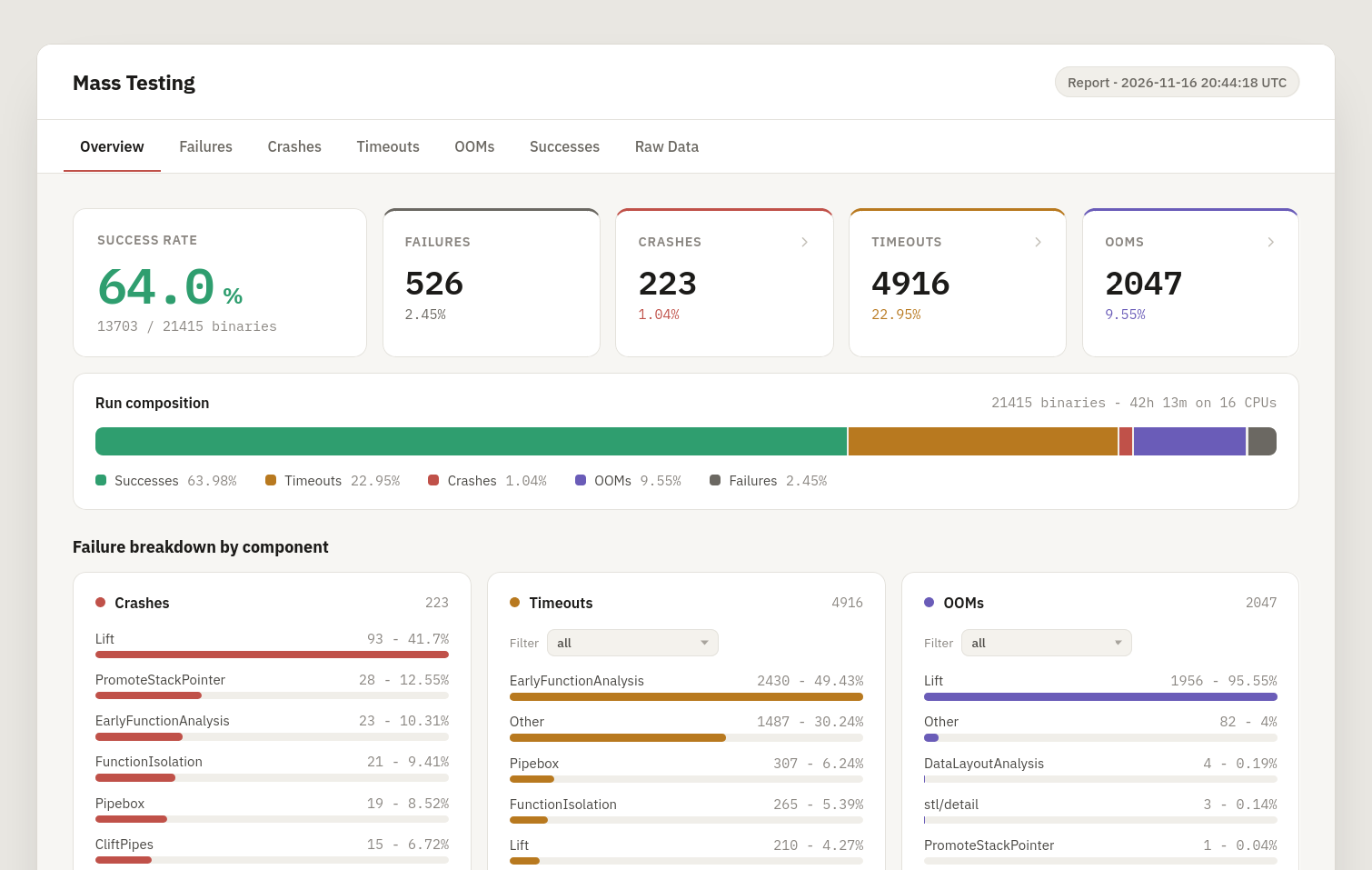
Every week, we run mass testing, a testing campaign where we decompile 20k+ binaries coming from Linux, Android and Windows installations and monitor the results in terms of success, crashes, timeouts and memory exhaustion.
This approach has been very effective in helping us prioritize fixes for the most common crashes and the most common performance bottlenecks. It also enables us to help users who cannot share the binary they are working on with us, but have a problem similar to one we already know about thanks to mass testing.
- Successes49%
- Invalid binary8.78%
- Crashes3.3%
- Timed out9.19%
- Out of memory29.73%
- Successes49.89%
- Invalid binary8.78%
- Crashes3.01%
- Timed out21.63%
- Out of memory16.68%
- Successes58.12%
- Invalid binary2.01%
- Crashes3.28%
- Timed out19.43%
- Out of memory17.16%
- Successes35.48%
- Invalid binary2%
- Crashes30.04%
- Timed out16.8%
- Out of memory15.68%
- Successes34.43%
- Invalid binary2%
- Crashes29.67%
- Timed out18.2%
- Out of memory15.69%
- Successes48.59%
- Invalid binary9.1%
- Crashes2.83%
- Timed out20.64%
- Out of memory18.84%
- Successes48.86%
- Invalid binary9.1%
- Crashes2.91%
- Timed out17.47%
- Out of memory21.66%
- Successes46.89%
- Invalid binary9.1%
- Crashes2.99%
- Timed out22.17%
- Out of memory18.85%
- Successes46.9%
- Invalid binary9.1%
- Crashes2.9%
- Timed out17.53%
- Out of memory23.57%
- Successes47.49%
- Invalid binary9.1%
- Crashes2.26%
- Timed out16.86%
- Out of memory24.28%
- Successes47.35%
- Invalid binary9.08%
- Crashes2.23%
- Timed out17.06%
- Out of memory24.28%
- Successes47.5%
- Invalid binary9.09%
- Crashes2.21%
- Timed out18.06%
- Out of memory23.14%
- Successes47.39%
- Invalid binary9.09%
- Crashes2.22%
- Timed out16.97%
- Out of memory24.32%
- Successes36.52%
- Invalid binary9.11%
- Crashes28.11%
- Timed out11.22%
- Out of memory15.05%
- Successes46.8%
- Invalid binary9.1%
- Crashes2.47%
- Timed out17.05%
- Out of memory24.58%
- Successes46.87%
- Invalid binary9.09%
- Crashes2.14%
- Timed out22.91%
- Out of memory18.99%
- Successes47.63%
- Invalid binary9.09%
- Crashes1.45%
- Timed out22.09%
- Out of memory19.74%
- Successes47.49%
- Invalid binary8.69%
- Crashes1.06%
- Timed out26.86%
- Out of memory15.89%
- Successes46.6%
- Invalid binary9.09%
- Crashes1.28%
- Timed out26.36%
- Out of memory16.67%
- Successes47.57%
- Invalid binary9.09%
- Crashes1.35%
- Timed out25.25%
- Out of memory16.73%
- Successes47.62%
- Invalid binary9.09%
- Crashes1.44%
- Timed out22.04%
- Out of memory19.81%
- Successes47.59%
- Invalid binary9.09%
- Crashes1.41%
- Timed out22.95%
- Out of memory18.96%
- Successes46.81%
- Invalid binary9.09%
- Crashes1.38%
- Timed out23.71%
- Out of memory19.01%
- Successes46.26%
- Invalid binary9.09%
- Crashes1.39%
- Timed out23.32%
- Out of memory19.93%
- Successes46.07%
- Invalid binary8.88%
- Crashes1.31%
- Timed out23.64%
- Out of memory20.1%
- Successes33.39%
- Invalid binary8.45%
- Crashes1.06%
- Timed out36.95%
- Out of memory20.15%
- Successes21.28%
- Invalid binary6.97%
- Crashes0.72%
- Timed out62.26%
- Out of memory8.77%
- Successes46.11%
- Invalid binary9.09%
- Crashes1.41%
- Timed out23.8%
- Out of memory19.58%
- Successes46.14%
- Invalid binary9.09%
- Crashes1.43%
- Timed out22.73%
- Out of memory20.61%
- Successes46.07%
- Invalid binary9.09%
- Crashes1.41%
- Timed out25.45%
- Out of memory17.98%
- Successes45.24%
- Invalid binary10.46%
- Crashes7.08%
- Timed out22.81%
- Out of memory14.41%
- Successes45.27%
- Invalid binary10.5%
- Crashes7.08%
- Timed out22.37%
- Out of memory14.77%
- Successes45.23%
- Invalid binary10.49%
- Crashes7.02%
- Timed out22.68%
- Out of memory14.58%
- Successes45.22%
- Invalid binary10.5%
- Crashes7.05%
- Timed out22.43%
- Out of memory14.81%
- Successes59.05%
- Invalid binary2.01%
- Crashes9.39%
- Timed out22.31%
- Out of memory7.25%
- Successes58.7%
- Invalid binary2%
- Crashes9.15%
- Timed out23.31%
- Out of memory6.85%
- Successes58.11%
- Invalid binary2%
- Crashes8.83%
- Timed out25.01%
- Out of memory6.05%
- Successes58.84%
- Invalid binary2.01%
- Crashes9.38%
- Timed out22.27%
- Out of memory7.5%
- Successes59.05%
- Invalid binary2.01%
- Crashes9.36%
- Timed out22.42%
- Out of memory7.17%
- Successes58.84%
- Invalid binary2.01%
- Crashes9.26%
- Timed out22.91%
- Out of memory6.98%
- Successes58.76%
- Invalid binary2.01%
- Crashes9.32%
- Timed out22.6%
- Out of memory7.31%
- Successes58.7%
- Invalid binary2.01%
- Crashes9.26%
- Timed out22.8%
- Out of memory7.24%
- Successes65.9%
- Invalid binary2.32%
- Crashes2.35%
- Timed out20.61%
- Out of memory8.82%
- Successes66.43%
- Invalid binary2.32%
- Crashes2.5%
- Timed out19.57%
- Out of memory9.19%
- Successes66%
- Invalid binary2.32%
- Crashes2.48%
- Timed out20.01%
- Out of memory9.19%
- Successes65.77%
- Invalid binary2.35%
- Crashes2.39%
- Timed out20.48%
- Out of memory9.02%
- Successes64.19%
- Invalid binary2.33%
- Crashes2.08%
- Timed out23.26%
- Out of memory8.14%
- Successes65.94%
- Invalid binary2.35%
- Crashes2.47%
- Timed out20.11%
- Out of memory9.12%
- Successes65.68%
- Invalid binary2.36%
- Crashes2.37%
- Timed out20.67%
- Out of memory8.92%
- Successes66.08%
- Invalid binary2.33%
- Crashes2.38%
- Timed out20.19%
- Out of memory9.02%
- Successes66.01%
- Invalid binary2.36%
- Crashes2.45%
- Timed out20%
- Out of memory9.18%
- Successes63.99%
- Invalid binary2.46%
- Crashes1.04%
- Timed out22.96%
- Out of memory9.56%
Over time, crashes went down from 7% to 1%. Also, between December 2025 and July 2026 we merged the new pipeline, which led to a reduction of timeouts from 14% to 7%.
Our goal is to reduce the number of crashes to 0 and to progressively reduce the number of timeouts and OOM situations, although we don't expect them to reach zero, since we set arbitrary limits in terms of time and memory usage for each binary, which chrome.exe is unlikely to fit into :).
Documentation
Along with the new pipeline infrastructure, we revamped the documentation, which now provides:
- a Your first decompilation document to get straight into using rev.ng;
- a proper reference for the CLI tools;
- a walkthrough explaining how our project file (aka the model) works;
- a tutorial on Python scripting;
- a detailed reference of the model and of the artifacts that rev.ng can produce.
What rev.ng supports today
As of today, the platform support in rev.ng is as follows:
- Architectures: x86/x86-64, ARM/AArch64, MIPS and s390x.
- Binary formats: ELF (+DWARF), PE/COFF (+PDB/CodeView) and Mach-O.
- Host: Linux x86-64. We're working on running rev.ng natively on macOS and Windows too, employing a new Nix-based build system.
What about other architectures, say, RISC-V or Hexagon? rev.ng lifts code using QEMU, so supporting an architecture QEMU already handles is not too much work. If you need one, let us know: it helps us decide what to do next and, if you can't wait, it's the kind of work we take on as a contract.
What about the cloud version? And what's next?
The improvements above are not available in the cloud version of rev.ng, and they won't be: we're suspending it. Thanks to all those who tried it and provided feedback: your help is greatly appreciated! hub.rev.ng remains available for public consultation.
The reason is that we've been busy building something new. We'll tell you more soon but, in the meantime, here's a sneak peek:
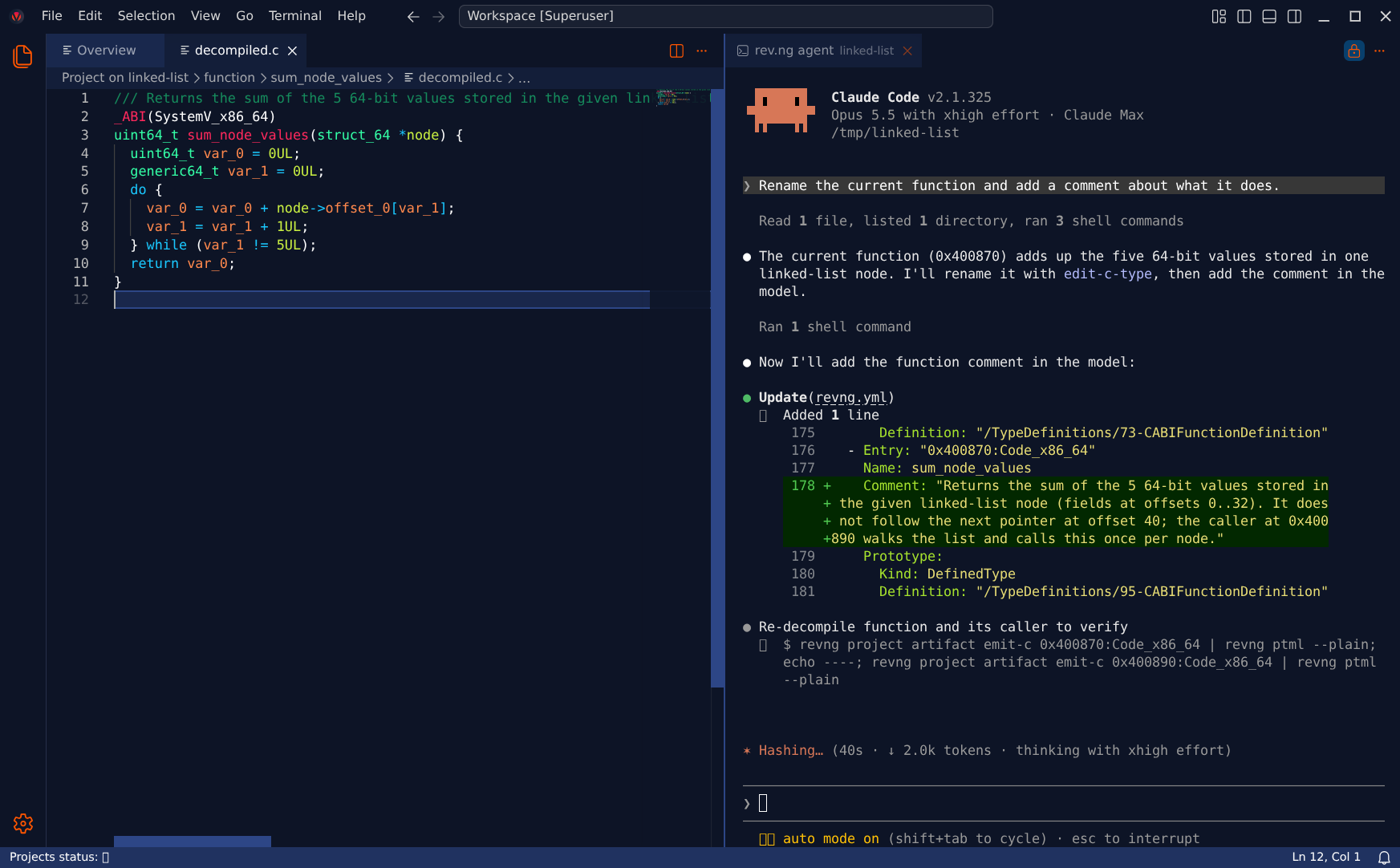
Subscribe to the newsletter to hear about it first.
Where to go from here
- Try rev.ng: set it up, run your first decompilation and tell us what breaks, on Discord or GitHub.
- Don't miss the next announcement: it goes to the newsletter first.
- Work with us: if what you've seen here is the kind of engineering your project needs, get in touch. Here's what we do for our customers.
- Join us: we're growing. If you'd rather build this than use it, take a look at our jobs.
See you in the next post! The wait won't be long ;)